Re-Introducing Turkeys

Lee Lesure and Hial Lobdell

Many people who have lived in town less than fifty years may not realize that there was a time when there were no wild turkeys. For a long time, they have been a large part of the wildlife one sees in the area. According to the Vermont Fish and Wildlife Department, wild turkeys are native to much of eastern America. Extensive land clearing for agriculture and hunting by settlers caused turkeys in the area to disappear for a hundred years. Much of our area has reforested, yet there is still a lot of agricultural and scrub land. This is ideal turkey habitat; they roost in forest trees but feed and nest on grass and scrub land.

Turkeys are social animals that prefer to live and travel in flocks. We see lone males in open areas in early spring. They puff themselves up to twice normal size and strut, hoping to attract a mate. If while you are driving you encounter a flock crossing a road, they may panic; some will run down the road, some will take flight. Either way, they can move at 25 to 30 miles an hour, allowing them to evade most predators. Turkeys are so plentiful that there has been a hunting season for many years.

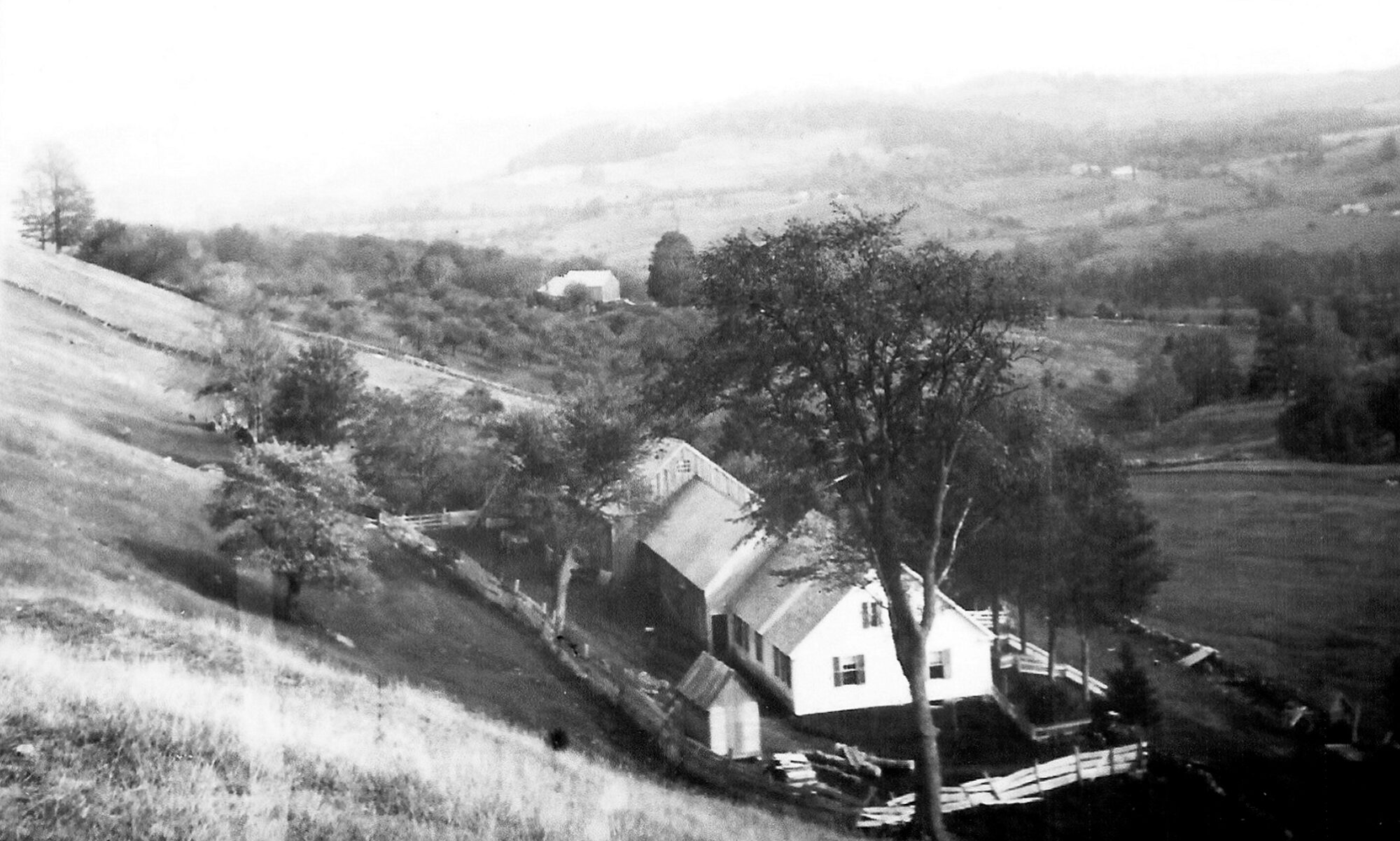
It’s been some time since HHS member Bev Lasure suggested I write about the re-introduction of wild turkeys in Hartland. I put it off for a long time because I had little material. Ironically, I was once present at one of the turkey releases but don’t remember where it was or who was there other than my father. Not too long ago, I found snapshots of Hial Lobdell and Lee Lasure releasing turkeys (Lee was Bev’s late husband). Hial’s daughter and HHS Board member Janet Hewes remembers the event. She said the turkeys flew a long way down a field before roosting in a tree. The Fish and Game clubhouse was the old district schoolhouse next to Lobdells’ house. The snapshots were dated ’67-’70. That’s when I would have witnessed a release in another location when I was home from college. So it’s coming together, except that the Fish and Wildlife site says they were first reintroduced in Rutland County in the winter of 1969–1970.

Someone said I should talk to Paul Howe. Well, I let that slide, and then the Howes left Hartland to live in Florida full time. Daughter Paula Staples bailed me out recently by talking turkeys while visiting her father in Florida. (Both the Stapleses and the Howes are HHS members.)

The first piece of information indicated that in the early ’50s the Hartland Fish and Game Club did the first turkey release in Vermont. My first reaction is that has must be so wrong. But the Fish and Wildlife website indicates that in the 1950s hundreds of game farm turkeys were released by individuals and by local fish and game groups. These birds were several generations removed from the wild, and none could survive the Vermont winters. So let’s consider Hartland the first to try.

Paul said the Hartland club bought three sets of two hens and a tom from Virginia. One set was released near Lance Williams’s (on Clay Hill Road, in the northern part of town). Another was released at Hial Lobdell’s (on Advent Hill Road, south of the first location). The third set was released on Brothers Road near the “Cat Farm” (farther south, but not much below the geographic center of town). The people involved were Harold Barbour, Hial Lobdell, Floyd Rockwood, Allen Brothers, Lawrence Young, Lance Williams, Paul Howe, Avery Howe, and Wright Foster.
Les Motschman

Hartland in the 50’s

The Hartland Historical Society is sometimes asked to provide a photograph for the annual Town Report. This year’s cover created interest among people of a certain age who grew up in town. It was a 1950 picture of the 1st and 2nd grades on the Three Corners School’s front steps. The names of the students were not included, but it seems many from that era went to work identifying their classmates. We now have a nearly complete list of the 44 students in the photo. There are no teachers in the photo.

I’m a little younger than the ones on the cover, but I know some of them. The cover prompted us to reminisce about school in those days, with one teacher, almost always a woman, in charge of 25 to 30 students, teaching, maintaining order, and meting out punishment. When I was talking with one of those in the photo, he asked if I had checked the staffing level at the present K–8 school. The Town Report, of course, has two sections, the Town and the School. Both give very detailed accounting of their operations. By my count, our K–8 school has about 60 staff for just under 300 students, about the same number we had for Grades 1–8 in the 1950s.

That cover has inspired me to start writing about Hartland in the ’50s. The decade has long been considered a golden era of happiness and prosperity when we saw significant economic growth. Europe and the Asian nations that participated in World War II were beaten down; everything was made in the U.S.A. Some people today would be quick to point out that the ’50s weren’t great for the large black minority in the country. Certainly true, but Vermont and much of Northern New England was nearly 100% white. There were also some poor families in town throughout the ’50s.

Hartland then had been slowly reversing a hundred-year trend of losing population. When men returned from WWII, they found good jobs, and they married. Couples started families, built or bought new houses, bought new cars, and even took vacations. I saw it happening as a young Baby Boomer. The Baby Boom was one of the most momentous demographic eras in American history. Baby Boomers still represent a large segment of the population in the country, certainly in Vermont, which along with Maine has the oldest population in the U.S.

The ’50s did get off to a bad start. Hartland men too young to serve in WWII were now being drafted for yet another war. After WWII, the U.S. and Russia partitioned the Korean peninsula. In June of 1950, the communist North invaded South Korea. A U.N. force consisting of mostly American troops pushed the communists out of the South and right up the peninsula toward the Chinese border. Alarmed, China sent 250,000 troops into the fray, making the U.N. forces retreat a very costly running battle. There was a two-year stalemate until an armistice was signed in July of 1953. Thirty-six thousand Americans died in the brief Korean War.

We at the Hartland Historical Society have a well-documented history of Hartland in the 1950s. Herb Ogden started publishing his Hartland News in February of 1952. After looking through several issues, I couldn’t help but think how much the topics resemble those on our modern List-Serv–for example, people then second-guessed the Selectmen or School Board, or complained about the condition of their roads, or wondered when they would be plowed. There was even discussion about gender issues and the effect of modern media on children. The one all-consuming challenge facing the Town was what to do about the schools. As the Baby Boomers added to the population in the ’50s, everyone knew something drastic needed to be done and that a lot of money would have to be spent. There were many proposals and countless meetings.

Hartland News – February 23

By Saturday night the great storm of the 17th had been licked. It took 85 hours of plowing by the three plow trucks and the bulldozer. Road Commissioner Harold Barbour had no estimate of the cost of the storm other than labor at $1/hour came to $595.
Osmer ran short of hay, but he only buys one bale at a time and will know better next time. Milk piled up at several farms: C. Best had 18 cans, D. Hoisington had 16, and F. Richardson got his out to the road by horse and stone boat. People living on some dead end stubs and remote stretches wondered when they would be plowed as the plows went by on the main road. John Bowley called Road Commissioner Barbour to task: “I live on a 1/2 –mile stub off from Hartland Hill Road and did not get plowed out until nine days after the storm.” Barbour apologized.


March 1

Flood Control Legislation from Vermont, Connecticut, New Hampshire, and Massachusetts has formed a Connecticut River Flood Control Compact. Some 10 reservoir sites will be set up in the headwater states. North Hartland is one of them. Communities involved will be recompensated by Massachusetts and Connecticut for loss of taxable property.


April, 4, 1952

SUGARING OPENS UP WITH SNOW HORSEBELLY DEEP
Thin Sap, Fancy Syrup, Snowshoe Gathering Mark New Season. Sugaring began here March 10th when Lyman, Maxfield and Rockwood began setting buckets. M. Adams started his floundering three days later. At least 15,000 buckets are hung in Hartland. There was no real sap run until the 17th – one day after the opening of the two-week “new moon in March” period. This is traditional sugar time and also when hard cider should be bottled.
While most struggled to gather on snowshoes in deep snow, Mesdames Minnes and Rudolph grinned and relaxed while their new tree-to-tree arch pipeline, from some 650 trees, ran full pipe. Most syrup made in Hartland is sold at retail, around $6 a gallon.
Armed Services – Brothers Lawrence and Richard Davis entered the Army and Navy respectively. A third brother, Corporal Robert Davis, is stationed at Fort Drum, N.Y. Pfc Avery Howe has received a medical discharge on account of stomach ulcers. He now works at Cones.


April 16, 1952

Selectmen postponed appointing two new Special School Committee members. Ogden, a member of the Committee, said if they put any more women on the Committee, they would have to replace him as well. Ogden said that mixed committees on basic problems do not cut much ice. Men and women reach their conclusions by basically different methods. Men hesitate to speak freely on such committees and at a showdown men are inclined to be too polite. Chairman Bradley asked “What’s the matter, Herbert, don’t you like working with women?” Persis Stillson, the only woman present, said “He just doesn’t like women, period!” As Editor of the paper, Ogden added: “(She exaggerated somewhat.)”

June 12, 1952

Present at the June 12th Selectmen’s meeting were Dean Bradley, Everett Miller, Kendall Adams, Phil Royce, Jim Howland, 2 public
There was discussion of the Mace Hill incident of that afternoon and the sewage disposal problem at a new house in Four Corners. Work is going forward on proceedings to get some 10 little-used roads either thrown up or designated as trails. No business of any consequence was transacted. No date was set for the next meeting.


July 1

Ground broken for new fire station alongside Town garage
Steven Lobdell and Conrad Hoisington have formed a hay-baling partnership. They bought (on time, naturally) a new Turner baler at the start of haying and have been right out straight since. It’s a big, impatient, snorting rig with a capacity up to 8 tons an hour. With rakes, mowers, trailers, and tractors, they will put some $6,750 worth of machinery on a man’s hayfield for the prevailing rate of 16¢ a bale. They also do miscellaneous tractor work and Steve has added chain sawing to his list.
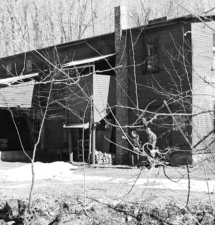
Hartland’s Most Remote Dwelling . The house, marked “camp” on the highway map, and barn are both small and homemade, but uncommonly neat and orderly. The garden, including asparagus and strawberries, is well-cared for. Leon Bettis, about 50 years old, and William, about 80, live there, approximately a mile off the Muskrat Hollow Road on Densmore Hill (now Creampot Road which has 30 houses). The road is in poor shape, good only for Jeep or truck. They have no car, but one horse. Leon hikes to South Woodstock for groceries, but William seldom leaves the place. He receives old-age assistance and does what he can around the farm. Leon does the heavy work. They have 20 cords of solid maple wood for sale, waiting only on someone with a truck to come get it.


There is more to tell, but I did not want to be nosey. The impressive thing is that they live way off from nowhere, on very little, yet do their work, maintain their self-respect and keep their place clean and right.
Les Motschman

Hartland in World War 1 (Part 2)

In the November issue, I stated that there were 62 names on the Hartland Honor Roll. I only wrote about the men whose war service was described by Walter Hatch. Some readers told me they enjoyed reading about Hartland guys who were old when we were young. Here are some more names from Mr. Hatch’s writing about members of the Hartland Legion Post.
Les Motschman

Hamilton Bail joined the Legion in 1946. He served in both wars. (I knew him in the 1970’s as my father did work for him. He lived in the brick house beyond Fairview Farm on the Dam Road.)
Dean McArthur is on the Hartland Honor Roll. He served in a Battery of the American Expedition Force. The McArthur farm was on the Quechee Road (Now the large brick house owned by the Littles). After his Army service he married and bought the property in Foundryville that was featured for sale in 1855 in the previous HHS newsletter. Mr. McArthur worked for the Hartland Telephone Company, which was owned by Ernest and Jennie English. He also worked in the garage Mr. English established as the first one in town. The garage was the red building near the Foundryville bridge across from the falling-down Telephone garage.
Paul Morrison ran a store in both North Hartland and Hartland Three Corners. He also served in both world wars.
William Carter will be remembered for his work at the Hartland Fair. In his younger days, Bill was a canvas man with a circus. He supervised the tent city at the Fair.
Fred Crowel worked in the area as a carpenter. He bought the old creamery building in the Four Corners and remodeled it into apartments (Now the bridal shop).
John B. Cawthorn married Dorothy Lamb and lived until his death in the brick house at the corner of Route 5 and Martinsville Road. He was from the Carolinas.
Rodney Burk was listed in the previous HHS newsletter as one of the Hartland men who went to France during the World War. Burk grew up on the Crandall Place on Weed Road (now Kennedy/O’Brien). I indicated that after the War he lived in the red house on the corner of Brownsville and County Roads (Gilberts), but it was probably the next house up County Road
as Mr. Hatch wrote that he built a cement dam above the house to store water for an ice harvesting business. At that time the Whiting Creamery in Four Corners stored a large quantity of ice to cool milk and cream in the summer. The milk and cream was shipped by rail to Whiting’s main plant in Boston. The dam is still visible, but the pond is mostly filled in.
Dean Bradley ran Fairview Farm on the Dam Road in North Hartland. He served with the American Expedition Force during the World War.
James Young worked at Fairview Farm and later started a trucking business. He was stationed in Fort Worth, Texas during the War.
Frederick Woodruff worked with the Red Cross in France during the War. He bought the house in Four Corners right on the corner of Route 12 and the Brownsville Road. He was involved with the small library that was across the street for many years. His wife Olga made the memorial that used to be on the Damon Hall lawn (It’s now in our HHS museum. It lists WWI, WWII and Korean War veterans from Hartland.).
Clint French was sent to the Clarkson College Training Depot in Pottsdam, NY during the War. He lived in a very old house in Foundryville (Now Derek Levin’s).
Deane Hoisington spent the War at the U. S. Naval Air Station in Halifax, Nova Scotia. NAS Halifax was established in 1918 as a base for “flying boats.” These large seaplanes had no landing gear and were used to patrol the North American coast looking for German U-Boats. (Wikipedia). His farm on Merritt Road still retains his name, even though he sold the farm in the 60’s and built a house nearby just off the Quechee Road.
Robert Patch is on the Hartland Honor Roll. He went into the garage business in Lebanon after the War. The Flanders and Patch name was still in use up until a couple of years ago.
Withington brothers Earle and Robert “Lyle” were from N. Hartland. During the War, Earle was at Camp Wright in Maryland and Robert was at Camp Devens in Massachusetts.
HHS member Judy Howland pointed out to me that I was spelling Osro Patch’s first name incorrectly (Osro, not Orso). That’s interesting because in the first part of his 13-page paper, Walter Hatch was misspelling his friend’s name wrong (Ozro).

Hartland in World War 1

Starting in 1848, Prussian Prime Minister Otto von Bismarck sought to unite the many German states into a German empire. Prussia was by far the largest and most populous state. Three successful wars against neighboring countries (Denmark 1864, Austria 1866 and France 1870-71) demonstrated to the citizenry how powerful a united Germany could be. Germany also created a colonial empire, claiming much of Africa not yet claimed by other European powers. As Bismarck was succeeded by Wilhelm II in 1890, the German Empire was becoming one of the most powerful nations in the world. It had the largest army; its navy was second only to the British Royal Navy. Germany had the largest economy in Europe and only the United States’ was larger.

By the turn of the century, many European nations had formed alliances for mutual defense. If one were attacked, allies would come to its aid. This arrangement set the stage for how a relatively minor event could lead to a truly global war. Germany was aligned with the Austro-Hungarian Empire and Italy. Under Bismarck it had been allied with Tsarist Russia, but Kaiser Wilhelm II had allowed that treaty to lapse. Russia then aligned with Britain and France.

On 28 June 1914, a Bosnian Serb and Yugoslavian nationalist assassinated the heir to the Austro-Hungarian throne, Archduke Franz Ferdinand, in Sarajevo, causing a diplomatic crisis. One month later, the Austro/Hungarians shelled the Serbian capital of Belgrade, starting the war. Soon Russia mobilized and France mobilized to support Russia. Germany invaded Belgium, causing it to invoke the 1839 Treaty of London, requiring Britain to join the war. Even Japan joined the Allied Powers as it hoped to seize German possessions in China and the Pacific. Italy left its alliance with Germany to join the Allies. The Ottoman Empire joined with Germany and the Austro-Hungarian Empire. Eventually fighting spread to the African colonies. In 1917, the Russian Revolution ended Tsarist autocracy, and Russian military resistance to Germany collapsed. Germany transferred a large number of troops to the Western Front.

After the sinking of seven U. S. merchant ships and the revelation that Germany was trying to incite Mexico to make war on its neighbor, the United States declared war on Germany on 6 April 1917. The U.S. had already been on somewhat of a war footing in that it had been providing war materials and foodstuffs to war-ravaged Europe for some time. The cover page of this issue is one of several large posters displayed in our museum. They were used to encourage men to sign up and citizens to buy War Bonds, in effect lending funds to the government so it could prosecute the war.

That the country was at war was evident right here in Hartland, where the National Guard was detailed to guard railroad bridges. Much of what we know about Hartland in the World War comes from a paper prepared by Walter Hatch in September, 1966. Mr. Hatch reprints an Honor Roll of 62 men who served in the War. It was prepared by Wilbur Sturtevant who was Town Clerk for fifty years. The men’s names are followed by the unit to which they were assigned.  The original handwritten Honor Roll is displayed in our museum.

  • Claude E. Wood had the highest rank of the Hartland men. He was commissioned Captain in the Medical Reserve Corps. He was the town’s doctor for many years. He had an office in his home in Three Corners on the left side of the road to Woodstock.
  • Lee Graham was a 1st Lieutenant in the Air Service. He was a graduate of Dartmouth and Harvard. Stationed in England, he was assigned to ferry a very old type of plane to France. He ran into a storm, the plane’s controls failed, and he crashed into a trash dump in Hastings, England, breaking his ankles.
  • Earle Graham was a 2nd Lieutenant in the Air Service, stationed at Love Field in Dallas, Texas. The Grahams grew up in the brick house near the Fire Station.
  • Rodney Burk was an Engineer in what was called the American Expeditionary Force (the AEF). Mr. Hatch recalls him later telling stories at hunting camp of his time in France, including building a bridge while under enemy fire. He lived in the red house on the corner where the County Road begins.
  • Elbridge Davis grew up in Hartland and Windsor. In the war, he was with a Coast Artillery Unit of the AEF.  When he returned, he married Eudora Sykes of Brownsville. They knew each other here but happened to meet in France where she was a WWI nurse. They had five children: Arthur was a well-known businessman in the area; Virginia married Micky Cochrane of Windsor and three of their children became Olympic skiers.
  • Mr. Hatch knew Orso Patch in Springfield where they grew up. When Hatch moved to Hartland in 1911, he roomed with the Patch family that was then living in the first house on Rice Road. Hatch worked at nearby Martin’s Mill. Orso went to France, where he drove a car for a Major.
  • The local National Guard trained during the summer of 1917 and sailed from Halifax on October 3, 1917. Frank Bement, Frank Russell and Ben Russell served in that unit. Ben was wounded in the Meuse offensive just before the war ended. The other two were in an ammunition train unit. Mr. Hatch recalls stories at hunting camp of what it was like in France to harness kicking mules to wagons at night while under orders to use no lights and make no sound. The roads were deep in mud and often ran through woods. Frank Bement married Ethel Russell [Yes, that happens a lot in wartime, your buddy’s sister starts writing you. In this case, they were classmates at Windsor High.].
  • Webb Hatch went to England on the Mauritania, without convoy as it was a fast ship. His unit crossed the Channel to Le Havre, France where they engaged in moving supplies. At first, they lived in tents in a muddy field but later were billeted in a barn’s hay loft, which was not so bad.
  • William Crane was one of the National Guard soldiers sent to guard the Martinsville railroad bridge when America entered the War. He later was in an artillery unit of the AEF. About three months after arriving in Hartland, William married a local girl, Mildred Howe, who was not yet seventeen. Mildred was born in 1900 and lived to 1992. She was aunt to Raymond, Viola, Paul, Avery and Laura Howe.
  • Walter Hatch was a corporal when discharged. He was stationed at an Aviation Repair Depot in Montgomery, Alabama. He lived in the house by the bridge just south of the Village. He was Marjorie Royce’s father. Mr. Hatch was involved with establishing an American Legion Post in Hartland in 1938. Much of his 1966 paper is concerned with members of the Legion—whom they married, what they did for work and leisure, and when they died. There was a lot of information about the old folks in town when I was growing up in the ‘50s and ‘60s.              

The majority of Hartland men served in units of the American Expeditionary Force and probably went overseas. Several were at camps or bases stateside. Five men were in specialized training at Dartmouth, UVM and Clarkson College when the war ended. Three Hartland men died in the war, all of disease: Winfred Morgan on March 11, 1918, Lester Harwood on September 26, 1918, and Isaac Springer on October 4, 1918 at sea. The disease may have been the “Spanish” flu. While millions of people died in the World War, tens of millions around the world died of the influenza that probably didn’t originate in Spain. Certainly that so many people were displaced by the war and troops moved from one place to another–often living in crowded, sometimes unsanitary, conditions–contributed to the spread of disease.

For a local perspective of the War, I scanned the 1918 weekly Vermont Journals published in Windsor. One article stated that deaths by influenza in the U.S. in just two weeks were far greater than those in the American Army in the past year. A November paper stated that the ban on places of public congregation and all other rules enforced for the prevention of the spread of influenza had been lifted on November 9. The Hartland News column noted that no events or meetings had been held at Damon Hall in October fbecause of the ban.

I wondered how I might learn how many Hartland people died from the Flu. I remembered something from the information HHS Secretary/Treasurer Pip Parker had provided me about the Howe family.  Mildred Howe had an older brother, Raymond Stickney Howe, who married a Hartland girl the same age as Mildred. Christine Barbour married June 18, 1917 and died October 19, 1918. Raymond then married her sister Hazel Barbour. According to the recorded Certificates of Death in the Hartland Town Clerk’s office, Christine’s cause of death was Pneumonia Lobar – Influenza. William Nugent, age 45, a Canadian working in a woolen mill, and Francis Spaulding, age 1, also died of the flu in early Fall 1918.

It’s apparent that civilians were expected to make sacrifices and volunteer for the war effort. At HHS, we have quilts that were made to raise money. We have several booklets in which groups of women kept track of the items they had made. They were making knitted items, surgical dressing, hospital garments, and so on.  An item in the Windsor paper stated that 8 million had volunteered for the Red Cross, and 291 million items had been made.

Every week included a section of the paper devoted to war news. By late summer of 1918, it was clear that Germany was nearly beaten, and discussion turned to what it would take to make the Germans surrender and what the terms should be. Articles encouraged farmers to produce as much as possible as Europe would need help long after the end of the War. The government was still asking landowners with walnut trees to sell them to sawmills with government contracts as walnut was the best wood for gunstocks and aero-plane propellers.

The November 5, 1918, edition reprinted an article from the Boston Globe, saying it would be especially interesting to Hartlanders. “Daniel Willard, Chairman of the Baltimore and Ohio R.R., has been appointed a Colonel of Engineers, U.S. Army, for duty in France. General Pershing recommended the appointment. The French Government has taken over operation of all French railroads and thought it desirable to have an American executive in view of the extensive use the American Expeditionary Force is making of those railways.” [Daniel Willard was born in North Hartland.] In Hartland news. “Deer hunters at Plymouth are F. A. Durphey, Frank Barrell, Frank French, A. B. Howe and Raymond Howe.”

Germany surrendered November 11, 1918. My grandparents’ generation knew it as Armistice Day. The U. S., Britain and France returned to peace; Germany was in chaos. Millions had died, great damage had been done, and the terms of the Peace Treaty were particularly harsh. Germany was marginalized by its former enemies. With no government, leftist and rightist groups fought for power. Just over twenty years after the Armistice, Germany would start an even larger World War.

Hartland Celebration: Those who were overseas didn’t come home immediately after Germany surrendered as there was still work to be done. It wasn’t until August 23, 1919 that Hartland held an all-day War Service Festival in honor of those from Hartland who served. The morning was devoted to sports. At noon there was a banquet at Damon Hall. At 2 p.m. there was band music and an address by Vermont’s Adjutant General. In the evening there was a band concert and dancing until midnight.

Background on Germany and the World War is mostly from Wikipedia. Thanks to Susan Motschman for typing and arranging and Pat Richardson for editing.

                                                                                    Les Motschman

From Hertford to Hartland via Waterford

From Hertford to Hartland via Waterford

Hartland was originally known as Hertford. It was chartered as such by New Hampshire on July 10th 1761, and then by New York in 1766.  According to “Thompson’s Vermont” the name Hertford was then change to Hartland on June 15th 1782. This isn’t quite correct. The name Hertford was actually changed to Waterford at an afternoon session of the Vermont Legislature on Saturday June 15th 1782. It then remained Waterford over Sunday and to the afternoon of Monday June 17th 1782, when “on motion of Paul Spooner the name was changed to Hartland”.

The act of legislature omits to record the brief 2-day name change to Waterford and reads:

Whereas, the town of Hertford lies contiguous to the Township of Hartford, which makes it difficult for strangers to distinguish which of said towns may be meant when either is spoken; and many other inconveniences,do attend the having two towns so near of one name in the State; which to remove: Be it enacted by the Representatives of the Freemen of the State of Vermont, in General Asembly met, and by the authority of the same, That the Township of land and incorporate Body, heretofore known by the name of Hertford, shall be hereafter called and be known by the name of Hartland.

Whilst it is still even now open to debate as to whether changing the name Hertford to Hartland actually succeeded in preventing any confusion with neighboring Hartford, the confusion at the time must have been even worse. This would have been due to the idiosyncrasies of British pronunciation, and the fact that the area at the time was held by the British following the 1763 Treaty of Paris.

In southern England there still exists a town called Hertford, in the county of Hertfordshire, the county name being more usually abbreviated to Herts. Unlike their spelling would lead one to believe, they are actually pronounced Hartford, Hartfordshire and Harts. In fact the name Hertford is actually derived from the words hart (a mature red deer stag) and ford (a river crossing). The earliest reference to the English town of Hertford appears in the Ecclesiastical History of the English People, written by Bede in 731 AD, which refers to “Herutford”. “Herut” is the Old English spelling of “hart“. The Domesday Book of 1086 gives a spelling of “Hertforde”.

The same confusion over the pronunciation between ‘Hert’ and ‘Hart’ also caused similar confusion in Hartford, Connecticut. That Hartford was originally called Newtown but it was changed to Hartford in 1637 in honor of founder and Puritan Pastor Samuel Stone’s hometown which was actually Hertford, England. So at least Hartford, Connecticut was written as it was pronounced. To an Englishman at the time (and even now), Hertford, VT would have been pronounced Hartford which would have been extremely confusing when you consider that there already was a Hartford, VT (which actually took the name from Hartford, Connecticut).

As to why Hartland became Waterford for only two days is unclear. The current Waterford in Vermont only became Waterford in 1797. Prior to that it was known as Littleton, but being directly across the Connecticut from Littleton, NH that was thought to be too confusing. There would have been no problem with Hertford becoming Waterford some 15 years earlier in 1782. Perhaps Paul Spooner wanted to retain some of the links and history of the name being Hertford, and so decided Hartland was a good compromise. Whilst I cannot find a direct link between the Spooner family and Hartland, England, it is generally believed that the name Hartland was taken from the English town or abbey of the same name. The small town of Hartland in England actually lies in the county of Devon. It was an important port up until Tudor times. Nearby is Hartland Abbey which was built in 1157. In 1539 it was the last monastery to be dissolved by Henry VIII. The King gave the abbey to his Sergeant of the Wine Cellar at Hampton Court. The Abbey is now the home of the Stucley family, the current owner being Sir Hugh George Copplestone Bampfylde Stucley (imagine writing all that on an application form!). The Abbey is open to the public and the website is well worth a look.

Almon Lull

Dr. Almon Lull


Almon Lull was born in Hartland in 1804, and died a millionaire in Glen County, California in 1894. His fortune was made from the goldrush although it was said that he did receive some unsolicited assistance in his rise from rags to riches, that assistance coming from a justice of the peace, a deputy sheriff and several constables from Windsor. It was also claimed that at one time his name was mentioned only in whispers by his Vermont relatives, if his name was even mentioned at all.

Little is known of his early life until the early 1830’s when he graduated from the medical college that flourished at that time in nearby Woodstock. According to family tradition he then served as an instructor in medicine at Dartmouth College although there is no trace of this in their records. Either the story is in error or Dartmouth made haste to erase his name from their records, a distinct possibility in light of subsequent events.

In early 1846 Almon arrived in Windsor accompanied by two medical students. There had been a recent burial at the Old South Church, and the three conspirators proceeded to disinter the body, supposedly for use in medical instruction. The operation however took longer than they expected and it was dawn by the time they had finished exhuming the body. Since they felt that it would unwise to risk loading the body into the wagon in daylight, they hid the body under the steps of the church and departed.

The next night they returned to complete their task, but unfortunately for them, the crime had been discovered and the bushes were alive with sheriffs, constables and irate citizens. All three were arrested. The following day the two students were released but Almon, as the ringleader, was dragged before a local justice of the peace. He was bound over for trial at the next session of the County Court at Woodstock and given the choice of spending the intervening months in the county jail or posting a cash bond of $500. His brother somehow managed to come up with the money and Almon was released. He immediately fled and headed West. He signed on as a surgeon for the assault upon Mexico, and then following the war he joined a wagon train of emigrants to California via the ‘Southern Route’. According to family history he is then recorded as being the first settler in the city of Berkeley (see note below).

The gold rush which began in 1849 soon brought swarms of men to San Francisco and it was this that made Almon his fortune. Whilst he himself never dug an ounce of gold, sickness was almost universal and due to the lack of doctors, a brief professional visit reportedly produced a fee of some $30 for just a 10 minute consultation, payable in gold, on the spot. His fortune grew rapidly and he soon became a great capitalist. At one time he reportedly owned all the ferry boats in the bay, thousands of acres of land, great herds of beef cattle and acres of wheat. He built business blocks in San Francisco and Sacramento. He sent recruiters to Windsor and neighboring areas to enlist young men for his various enterprises and many apparently left Vermont on that account.

Towards the end of his life he did in fact return to Windsor, his sudden departure nearly 50 years before apparently long forgotten by the authorities here. He cut an imposing figure with his silk top hat, elegant clothing and a black cane with an enormous gold head.

Surviving relatives in Hartland hoped to inherit some of Almon’s fortune upon his passing but were sadly disappointed. They received notification that they were to receive something and had visions of inheriting large sums of gold. A parcel duly arrived and the family went to the express office to claim their inheritance. It was something of a shock when they were informed that they had to pay $1.50 for express charges. It was a further shock to find that the long slim package they received contained no gold, but only the famous gold-headed cane. Not only that, but the cane was broken and a cabinet maker in Windsor charged another $1.50 to repair it. There was further disappointment when the ‘gold’ head was examined by a jeweler who informed the family that it was actually made of brass lightly plated with gold. The final let down came when it was discovered that the cane was actually entailed and was to be forever passed down to his brother’s oldest living male descendent. Thus the family’s dreams of a great inheritance were ended.


Notes:

This story is based on the recollections of Col. Thomas Lull (1883-1960). Dr. Almon Lull was his great uncle. Almon and Thomas’s grandfather Morris were both sons of Titus Lull (1773-1844) who is buried in the Jenneville Cemetery. I believe that Titus may have been a son of Timothy Lull, an early settler in Hartland who gave his name to Lull Brook. Unfortunately I have been unable to verify this information.

I can find no mention of Almon being associated with Berkeley. However there is a link close to home. According to the Centennial Record of the University of California, “In 1866…at Founders’ Rock, a group of College of California men watched two ships standing out to sea through the Golden Gate. One of them, Frederick Billings, thought of the lines of the Anglo-Irish Anglican Bishop George Berkeley, ‘westward the course of empire takes its way,’ and suggested that the town and college site be named for the eighteenth-century Anglo-Irish philosopher.”  Although the philosopher’s name is pronounced “bark-lee”, the pronunciation of the city’s name has evolved to suit American English as “burk-lee”. Frederick Billings is of course associated with Woodstock.

In some versions of the history of Princeton, California it reads –

 “Almon Lull, MD, is credited with naming the town and applying for the post office there. He had about fifty     signatures on the petition he circulated. Throughout local history writings, it is said Dr. Lull graduated from Princeton University and thus the name. This is not proven, and it doesn’t appear that he attended Princeton or even lived in New Jersey.”

Hartland in the Civil War – Part 7

Seventh Installment By Les Motschman

Constant Conflict

Last spring’s newsletter described the terrible Battle of The Wilderness and ended with the running battle between the two armies through Spotsylvania and Cold Harbor. There was no break from the fighting. Elements of both armies engaged each other all over northern Virginia throughout the summer and fall of 1864. Some clashes named for the nearest town or crossroads hamlet are quite well known. Many lesser engagements are hardly known at all except that officers’ reports duly note every interaction with the enemy. In his Hartland in the Civil War of fifty years ago, Howland Atwood mentions several engagements where he had determined that Hartland soldiers were present.
General Lee expected a full-scale attack on Richmond, but General Grant moved instead on Petersburg, an important Confederate supply base. Wilmington, North Carolina, was the only Confederate port still open and three railroads moved supplies from there to Petersburg and Richmond. In mid-June 1864, Petersburg was scantily fortified, but confusion among Grant’s subordinates caused a delay in taking it before Confederate troops arrived and strengthened its defenses. Grant called for a belated heavy attack but soon called it off when he realized Petersburg could not be taken by assault. Petersburg might have been taken in a day; instead the Federals laid siege to it. The siege lasted ten months. “Blundering” Bob Butler, a Massachusetts politician with no prior military experience, who was made a general at the start of the War, was blamed for not taking the town when ordered to do so. He had failed Grant and other commanders before, but President Lincoln would not dismiss him because of his influence in Massachusetts–The nation would vote for President in a few months, and Lincoln’s re-election was by no means a sure thing. The five Vermont regiments of the “Old Brigade” were at Petersburg.

Weldon Railroad – June 23, 1864

The Weldon Railroad engagement was not militarily important, but a tentative and poorly coordinated movement to destroy the railroad was very costly for Vermont troops. Operating near an area where 1700 Union soldiers had been captured the day before, the Vermont regiments battling Confederates near the railroad did not receive the order to retreat. Forty-nine Vermonters were killed, and 412 were taken prisoner. The captured were marched to the prison camp at Andersonville, Georgia, where 203 died and many of the survivors were permanently disabled. From the 11th Vermont, Edgar Leonard was mortally wounded and Elisha Spaulding was taken prisoner but paroled on Sept. 1. The Vermont 4th, 6th, and 10th, and the 1st Vermont Cavalry regiments also saw action there.

Monocacy, Maryland – July 9, 1864
After Cold Harbor, General Lee learned that a Union force was heading up the Shenandoah Valley. Though short of troops, Lee dispatched General Jubal Early and his Confederate corps to clear the valley and frighten Washington. At Monocacy, Early’s 15,000 Confederates overwhelmed the 5,000-man Union force assembled to slow the move on Washington. The nine-hour battle was important in that it delayed the Confederate advance, while a larger Union force sent by Gen. Grant made its way toward Washington. Atwood believes Hartland soldiers Charles Colby, Charles Colston and Seneca Young of the 10th Vermont were in the battle.

Fort Stevens, Maryland – July 11-12, 1864
From Monocacy, Early marched his men thirty miles toward Washington. They halted at Fort Stevens inside the district’s line on Seventh Street to assess the fort’s defenses. In fact, Washington’s defenses were poorly manned at that time. When the alarm was sounded, government clerks, home guards, invalid soldiers and casual detachments of soldiers in the city rushed to its defense. President Lincoln, looking through a glass at the White House, could see steamers in Alexandria arriving to unload veteran combat troops sent by General Grant. Soon, men in blue were filing into the fort and some formed a battle line in front.
Inexplicitly, Lincoln went to the fort himself to see how the confrontation would play out. When Early attacked, the President was standing on a parapet, a real concern for the officers accompanying him. As bullets started whizzing by, a surgeon was hit in the ankle and an officer was killed. Some accounts note an officer profanely cursed his Commander-in-Chief until Lincoln removed himself from danger.
The President had sent hundreds of thousands of men off to war. He had visited battlefields to see the resulting carnage. He had seen the wounded return to Washington in ambulances. He visited the hospitals to talk with the wounded and hold their hands. On this day, he saw first-hand many of his fine troops, under a rain of enemy fire, fall wounded or dead.
Early realized that the prize of Washington, so close, was not within his grasp. The Confederates withdrew to the Shenandoah Valley, leaving 400 wounded behind.

Les’s note: Howland Atwood ventures that helping to repel Early’s assault on the nation’s capital may have been Hartland’s most important contribution to the outcome of the war. If Early’s army hadn’t been delayed at Monocacy, it might not have been repulsed at Fort Stevens. American history from that point on would differ from what we know. One can only imagine the events that would unfold if the Confederate Army had been able to sack and burn Washington before the Union troops arrived. It would have sent a shockwave throughout a war-weary North. The war might have ended on terms more favorable to the Confederacy. Slavery might not have been abolished at that time. Who knows what a reconstituted United States would look like going forward? By my count, from the rosters of the Vermont 3rd, 5th, 6th, and 11th regiments that were at Fort Stevens, there could have been as many as twenty-four Hartland men in the battle. It would take a look at each soldier’s actual service record to determine who was fit for duty at that time, as several of the men had been wounded a few weeks earlier in the Overland Campaign.

The Army of Shenandoah
Following the battle at Fort Stevens, General Grant decided he would send an army after the Confederate force that had threatened Washington. It was time to wrest control of the Shenandoah Valley from the rebels. Earlier in the war, a large Union force had entered the Valley but had been beaten back at every turn by General Stonewall Jackson’s army. The Shenandoah Valley was Virginia’s breadbasket and it supplied food for the Army of Northern Virginia. Vermonters serving there likened it to the Champlain Valley without the lake. Grant placed General Phil Sheridan in command of the new Army of the Shenandoah. It consisted of some of the finest troops from the Army of the Potomac, including the Vermont 3rd, 4th, 5th, 6th, and 11th Regiments. The 1st Vermont Cavalry was also operating in the Valley.

Charles Town, West Virginia – August 21, 1864
Charles Town was founded by George Washington’s brother, Charles. In 1859 John Brown was tried, sentenced and hung here for treason. He prophesied “Many more lives than mine will be spent before slavery vanished.”
For a month the opposing armies maneuvered around each other. Then came the battle of Charles Town. The 6th Vermont reported being in a sharp battle, suffering more casualties than any other regiment. John Willard of the 1st Vermont Cavalry was taken prisoner.
Les’s note: A large part of Virginia beyond the Allegheny Mountains became the state of West Virginia in 1863. Residents in the mountains there and also East Tennessee did not depend on a slave economy, so they generally were not sympathetic to the Southern cause.

Winchester, Virginia – September 19, 1864
Sheridan defeated Jubal Early in an all-day battle at Winchester, also known as Opequan Creek. The Federals took 2,500 rebels prisoner. Sheridan began a “scorched earth” policy, destroying all crops and any food fit for man or beast. Barn fires everywhere illuminated the night sky. The usual five Vermont regiments were there along with the 8th and 10th. Frederick Small of the 1st Vt. Cavalry was wounded at Winchester.

Cedar Creek, Virginia – October 19, 1864
Most Vermonters likely recognize the name of Cedar Creek, even if they do not know its significance. A distinctive feature in the Vermont State House is the Cedar Creek Room on the second floor. A giant painting by Julian Scott on one wall depicts the Vermont troops’ role in saving the day at the Battle of Cedar Creek.
After the rout at Winchester, Sheridan’s Army of the Shenandoah went into camp for a well-earned rest. Sheridan went to Washington to report to his superiors. Meanwhile, the Confederate general, Early, had received some reinforcements and wanted to make one more run at Sheridan’s army. Confederate scouts
were atop a small mountain in the Valley looking down on the Union encampment, evaluating its defenses. Early sent 7,000 men quietly through the night to take up positions opposite the Union line. At first light the screaming rebels emerged from the heavy fog and overran the Union camp. Dazed Union troops ran from the oncoming mass of gray. Those who were left of the battered 8th Vermont Regiment, along with a few hundred other Union soldiers, were ordered to make a stand against the surging rebels so that the main army could escape, regroup and form a battle line. Such an order seemed like a certain death sentence as the gray wave engaged the defenders in hand-to-hand combat.
Gen. Sheridan could hear the battle begin twelve miles away in Winchester. His army had been pushed back four miles. Sheridan galloped back to lead his army. He urged the retreating soldiers he encountered to turn back. Because the men had the utmost respect for their commander, many did so. A thin Federal line was forming to receive an expected final massive assault. The rebels didn’t attack, and at 4 p.m. Sheridan ordered a counterattack across the ground given up earlier in the day. For a while it seemed as if the Confederates might hold their positions until nightfall. Later in the day, though, General George Custer’s cavalry, including William Wells’ 1st Vermont Cavalry, joined the battle and Cedar Creek became a rout. The great Union victory electrified the North, assuring Lincoln’s re-election a couple weeks later.
Five hundred Vermonters were killed, wounded or went missing at Cedar Creek. Of the 159 members of the 8th Vermont making the valiant stand against the rebel onslaught, 100 were shot or captured. We know of only one man from Hartland in the 8th Vermont Infantry Regiment. Thomas Geer joined the 8th on August 12, 1864, just in time to become part of the Army of the Shenandoah. He died of disease four months later. Judah Dana was wounded and Eldridge Thompson was killed at Cedar Creek. Both were with the 3rd Vt. Regiment.

Les’s note: For much of this installment, I have relied on Howland Atwood’s work of fifty years ago. To describe the Battle of Cedar Creek, I referred to Howard Coffin’s book Full Duty. Coffin has said that the 8th Vermont’s role in delaying the initial Confederate attack and the full Vermont Brigade’s participation in the successful counter attack may have been Vermont’s single greatest contribution to winning the Civil War. Coffin was instrumental in securing placement of a historical marker near the battlefield this past October for the 150th observance of the Shenandoah campaign. The marker details the story of Vermonters at Cedar Creek and says “Vermont soldiers played an important role in the Union Victory.”

The St. Albans Raid – October 19, 1864

On the same day as the Battle of Cedar Creek, the Civil War’s northernmost action took place right here in Vermont. Nineteen Confederate soldiers rode twelve miles from Canada to rob three banks in St. Albans. They shot and killed one man and tried to set the town on fire. After returning to Canada, the soldiers were arrested and held there. Most of the money was returned. The raid was one of several planned along the northern border, but the only one carried out. The objectives were to cause the Union to move troops to the border and acquire much needed money.

Men credited to Hartland who enlisted in late 1864
3rd Vt. Inf. Reg. 8th Vt. Inf. Reg. 1st Vt. Cavalry Gaius Thompson Thomas Geer Cyrus Bagley* Asa Benway 4th Vt. Inf. Reg. 9th Vt. Inf. Reg. Frederick Blaisdale John Douglas Richard Wheeler Hiram King Ferdinand Fallon* George Martin 17th Vt. Inf. Reg. Franklin Parker 5th Vt. Inf. Reg. George Hurley James Sleeper* John Blanchard John Temple* Frederick Small* Andrew Walker 6th Vt. Inf. Reg. 3rd VLAB** Zina Walker Thomas Kneen Cornelius Bagley Albert Willard Herman Orcutt Dwight Bagley Thomas Willard Hosea Young 2nd USSS*** William Petrie

* Nine-Months men who reinlisted ** VLAB – Vt. Light Artillery Battery *** U.S. Sharp Shooters (snipers)

Hartland soldiers James Emery of the 6th and Benjamin Hill of the 11th died of disease in late 1864.

The Election of 1864
Never before had the world seen anything like the election of 1864. A nation was preparing to hold free elections in the midst of a violent civil war. When people voted President, they would in effect be voting on whether to stop the war effort or to carry on to victory at any cost. Secretary of the Treasury Salmon P. Chase (from Cornish, New Hampshire) made a bid to replace Lincoln as the Republican nominee. Lincoln was renominated but did not campaign. His prosecution of the war would be the principal issue. The Democrats nominated General George McClellan, who was Lincoln’s first choice to lead the Army of the Potomac early in the war. McClellan’s tentative use of his great army against a much smaller Confederate force in the Peninsula Campaign had caused Lincoln to remove him as commander.
The military campaigns of the spring and summer of 1864 looked like failures. Lee remained unbeaten; neither Richmond nor Atlanta had been taken; the Confederates had recently made a brash move on
Washington. The Emancipation Act and the Union’s enlisting black soldiers inadvertently led to the creation of prisoner-of-war camps in both the North and the South. Tens of thousands of soldiers were housed in those dreadful prisons. Casualties in battle were higher than ever. To top it all off, Lincoln called for a new draft of 500,000 men. Lincoln did not believe he would be re-elected.

Les’s note: Some of the information above is from Bruce Catton’s 1960 book Civil War.